

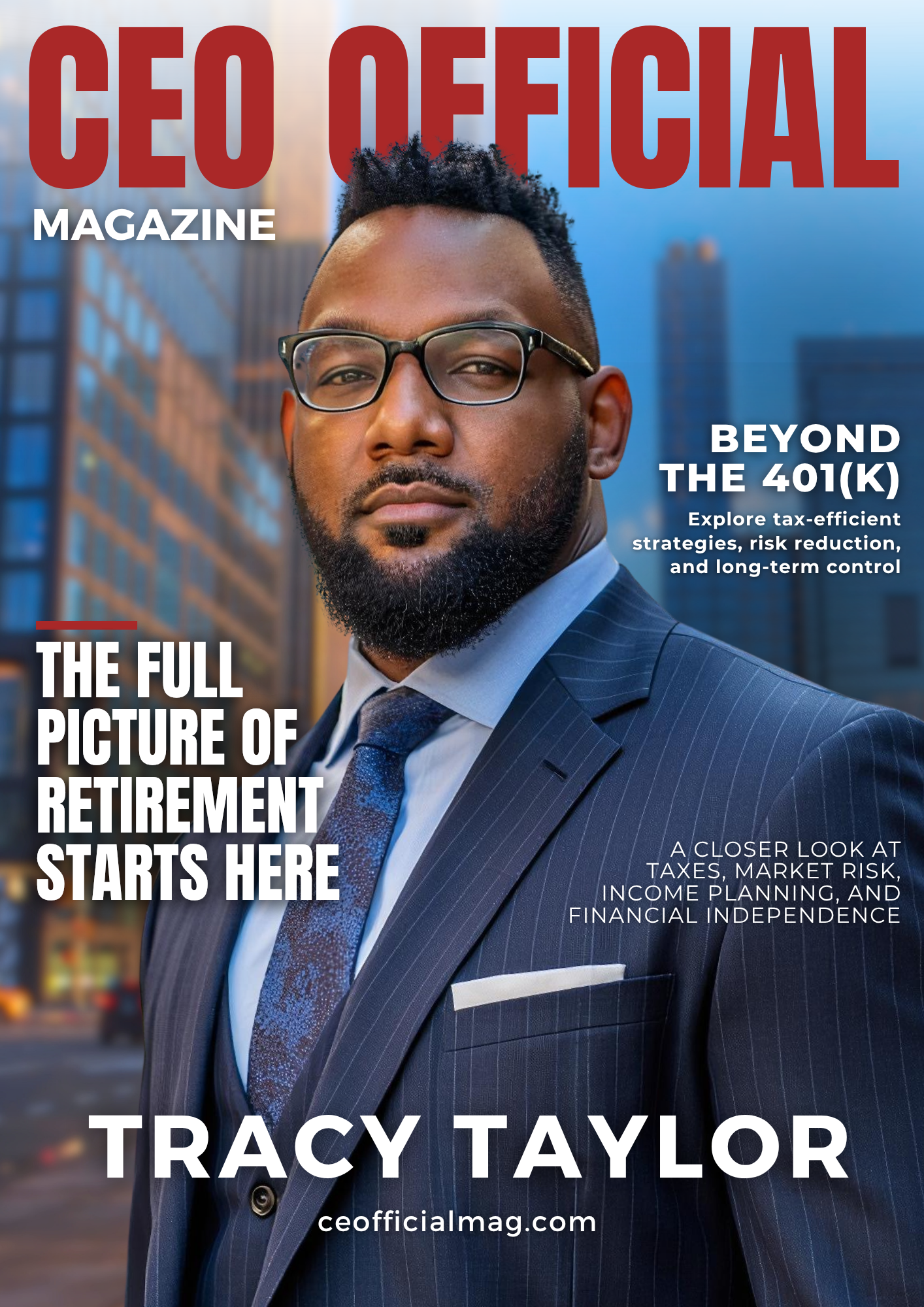
For decades, Americans have been told the same story about retirement.
Save into a 401(k). Contribute to an IRA. Let time and the market do the rest.
On the surface, it sounds responsible. Even safe.
But according to financial professional Tracy Taylor, that story is incomplete. And for many families, it could quietly lead to unexpected taxes, reduced income, and unnecessary risk at the exact moment they can least afford it.
Taylor believes the real issue is not that people are saving incorrectly.
It is that they are not being shown the full picture.
And once you see the full picture, everything changes.
A Personal Moment That Changed Everything
Tracy Taylor’s mission did not start in a boardroom.
It started in a moment of grief.
When his father passed away, Taylor found himself sitting in a wealth management meeting with his family, facing uncertainty during one of the most emotional periods of his life. At that moment, something unexpected happened. The guidance they received brought clarity. It brought structure. It brought relief when everything else felt uncertain.
That experience became a turning point.
He realized most people do not need more financial products.
They need clarity when life feels overwhelming.
That moment ultimately shaped his entire career in financial services, where his mission became simple: help families understand their options, reduce uncertainty, and build strategies that actually align with their real lives.
As he describes it, financial planning is not just numbers.
It is walking people through some of the most important decisions of their lives with confidence and education.
The Retirement System Most People Are Following Has Hidden Weak Points
Taylor warns that the traditional retirement system many people rely on is built on assumptions most clients never question.
And those assumptions create blind spots.
Here is what most people are told:
- Save consistently
- Use tax-deferred accounts like 401(k)s and IRAs
- Wait until retirement
- Withdraw later when needed
But what is rarely explained is what this system actually means in practice.
The Hidden Pitfalls of Tax-Deferred Retirement Accounts
According to Taylor, tax-deferred strategies often come with risks that are not clearly communicated:
- Taxes are delayed, not eliminated
- Withdrawals in retirement may be fully taxable
- Future tax rates are unknown
- Clients may end up paying more than expected when they need income most
- Market exposure creates timing risk
- Accounts rise and fall with the market
- A downturn near retirement can significantly reduce available income
- There is limited time to recover losses when withdrawals begin
- Fees quietly reduce long-term growth
- Management fees and fund expenses compound over time
- Even small percentages can significantly reduce retirement savings over decades
- Many clients are unaware of total lifetime cost impact
- Access is restricted
- Early withdrawals can trigger penalties
- Funds are often locked until age 59½
- Flexibility is limited when life events happen unexpectedly
- No guaranteed income structure
- Account balances do not equal income certainty
- Retirees may not know how long their money will last
- Planning becomes reactive instead of structured
Taylor’s concern is not that these tools are “bad.”
It is that people believe they are more predictable than they actually are.
And in retirement planning, unpredictability is the real risk.
Why Most People Never Hear About Tax-Free Strategies
One of the biggest gaps in financial education, according to Taylor, is the lack of awareness around tax-free planning strategies.
Most people are never introduced to alternatives beyond employer-sponsored retirement accounts.
And that creates a narrow financial worldview.
Taylor explains it this way:
If you only see one path, you assume it is the only path.
But it is not.
The Shift: From Tax-Deferred to Tax-Free Financial Strategy
Taylor helps clients explore strategies designed to shift their financial structure from tax-deferred accumulation to more tax-efficient, and in some cases tax-free, long-term planning approaches.
The goal is not complexity.
The goal is control.
Potential Advantages of Tax-Free Planning Approaches
When properly structured, tax-free strategies may offer:
- Tax-Free Growth Potential: Money can grow without the same future tax exposure as traditional accounts.
- More Efficient Wealth Retention: Clients may retain significantly more of their long-term gains over time.
- Principal Protection Features: Some strategies help protect against market downturns and volatility.
- Liquidity and Flexibility: Access to funds without the same penalties or restrictions as traditional retirement accounts.
- Predictable Income Planning: Greater structure around retirement income instead of relying solely on market performance.
Taylor emphasizes that these strategies are not about replacing everything people already have.
They are about filling in the gaps traditional systems often leave behind.
Capital Preservation and Risk Reduction Matter More Than Ever
One of the biggest shifts Taylor sees in clients is not just concern about taxes.
It is concern about loss.
People are realizing that growing wealth is only half the equation.
Keeping it matters just as much.
That is why risk management plays a central role in his philosophy.
In volatile markets, even strong portfolios can experience:
- Sudden drawdowns
- Emotional decision-making
- Retirement delays
- Reduced lifetime income
Taylor’s approach focuses heavily on eliminating unnecessary exposure where possible and ensuring clients understand what level of risk they are truly carrying.
Because most people do not lose money because they invest poorly.
They lose money because they did not realize how exposed they were.
A Real Client Impact That Changed Perspective
One of Taylor’s most meaningful client experiences involved a woman who came in carrying both financial stress and uncertainty about her future.
Through structured planning, debt reduction strategies, and long-term forecasting, Taylor was able to help her:
- Reduce financial pressure
- Create a clearer retirement roadmap
- Rebuild confidence in her future
- Reintroduce life goals she believed were no longer possible, including IVF planning
This is the part of financial planning that often gets overlooked.
It is not just about retirement age.
It is about what becomes possible again once clarity is restored.
Why Education Is the Core of Everything
Taylor’s entire philosophy is built around one principle: informed clients make better decisions.
That means:
- Explaining the “why” behind strategies
- Breaking down complex financial concepts into clear language
- Showing tradeoffs instead of hiding them
- Encouraging long-term thinking over emotional reactions
He believes financial confusion is one of the biggest threats to retirement success.
Not markets.
Not taxes.
Confusion.
The Core Values Driving His Work
Taylor’s approach is shaped by five foundational principles:
- Integrity: Every recommendation must serve the client’s best interest
- Service: Clients come before transactions
- Relationships: Planning is long-term, not transactional
- Education: Understanding is more valuable than instruction
- Courage: Clients must be willing to make informed financial decisions even when uncomfortable
These are not slogans.
They are the standard he operates by.
The Bigger Problem: People Are Planning Without Full Information
Taylor believes the financial industry has normalized partial education.
Most people:
- Do not fully understand tax implications in retirement
- Do not know how fees impact lifetime savings
- Do not understand withdrawal risks during market downturns
- Do not realize alternatives may exist
And that lack of awareness leads to decisions made on incomplete information.
His mission is to change that.
What True Financial Independence Actually Looks Like
To Taylor, financial independence is not just a number in an account.
It is:
- Knowing your income is structured
- Understanding your tax exposure
- Having access to your money when you need it
- Reducing unnecessary risk
- Feeling confident about the future instead of uncertain
It is not about predicting the market.
It is about building a system that does not depend on it behaving perfectly.
A Mission Rooted in Legacy and Purpose
Taylor’s motivation extends beyond finance.
His legacy goals are deeply personal.
He wants to:
- Serve disciplined, resilient individuals who value long-term thinking
- Provide stability and security for his own family
- Show his son what work ethic and purpose look like in practice
- Honor his mother’s sacrifices through his success
- Expand support efforts for incarcerated individuals re-entering society through rehabilitation and skill-building programs
For Taylor, wealth is not the end goal.
It is a tool for impact.
Conclusion: It Is Time to See the Full Picture
Retirement planning should not feel like guesswork.
But for many families, it does.
Tracy Taylor believes the solution is not more complex.
It is better education, better structure, and better awareness of the tools available beyond traditional retirement accounts.
Because once you understand how tax-deferred systems work, what risks they carry, and what alternatives may exist, you can finally make decisions with clarity instead of assumption.
And that changes everything.
If you are ready to explore strategies that may reduce tax exposure, limit unnecessary risk, and help you build a more structured financial future, the next step is simple.