

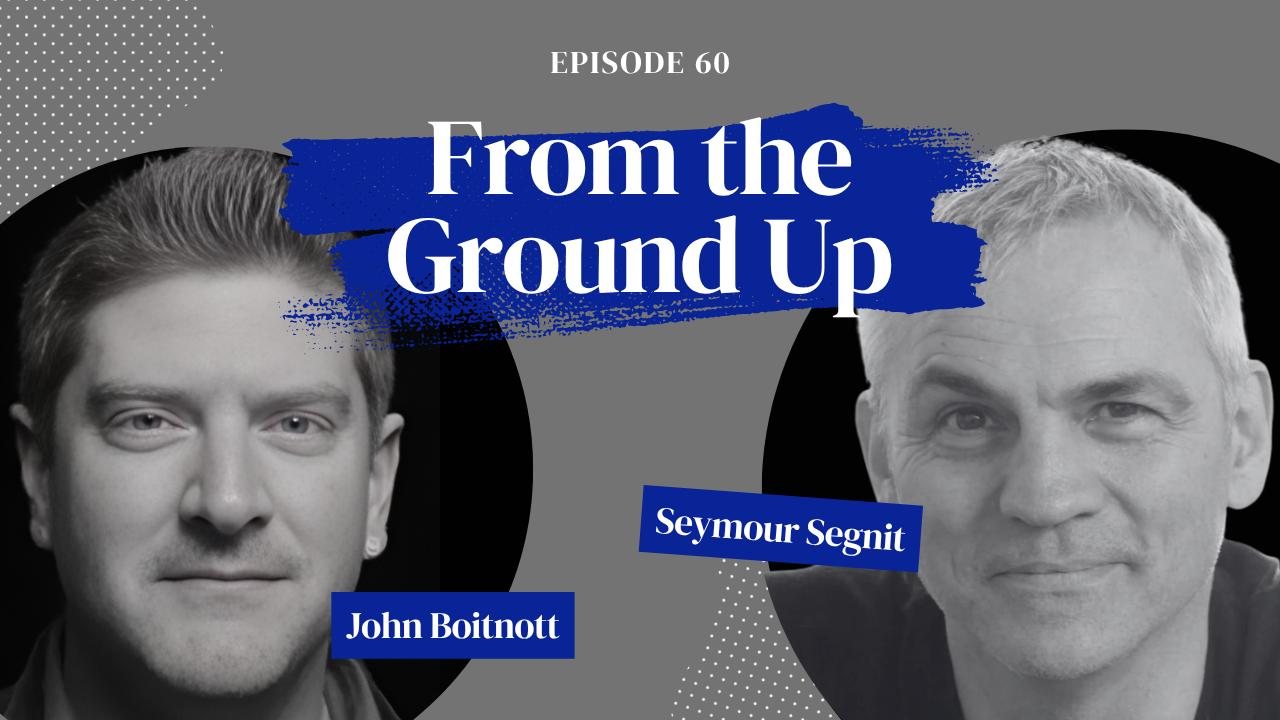
Seymour Segnit’s story with MAGFAST begins in a place most people recognize immediately. It begins with a drawer full of tangled wires, old charging cables, forgotten adapters, and half-useful electronics that somehow never quite solve the problem they were bought to fix.
For Segnit, that ordinary frustration became the starting point for a company.
His path there was not linear. Born in North London, Segnit studied engineering at Oxford, though he is quick to acknowledge that the academic version of engineering never fully captured him. From there, he moved into advertising, radio, software, entrepreneurship, and eventually the United States, where he spent time in the Bay Area and became increasingly drawn to the intersection of product, communication, and customer experience.
Those pieces would later matter more than any single credential.
Advertising taught him that marketing is not simply a department, but a fundamental skill for making ideas understood. Software taught him how systems can bring together information that would otherwise remain scattered. Training in language and communication helped him think about how people process ideas, make decisions, and tell themselves stories about what is possible.
MAGFAST emerged when all of that experience met a very practical problem.
A little over a decade ago, Segnit was trying to organize charging in his own home and found that the available products were not good enough. Some worked, but none felt satisfying. They did not solve the deeper mess of modern device charging in a way that felt elegant, durable, or enjoyable. That gap led to an idea, then to an early crowdfunding campaign, and eventually to a company built around a more ambitious vision for charging.
The early response was powerful.
MAGFAST attracted major support through pre-orders, including a launch that brought in hundreds of thousands of dollars in a matter of minutes and significant momentum within the first day. The response validated the idea that customers were willing to support a different kind of charging product, especially one presented with care, clarity, and a sense of occasion.
Then the hard part began.
The company ran into problems almost immediately, starting with payment processing issues that held up funds and created pressure at the exact moment momentum should have been converting into execution. Product development proved more complicated than expected. Teams struggled. Timelines slipped. Delays accumulated. For years, MAGFAST found itself seemingly close to a breakthrough while still fighting through technical, operational, and manufacturing setbacks.
For many companies, that kind of stretch can become fatal because silence fills the space where trust used to be.
Segnit chose a different route. MAGFAST communicated regularly with customers, often through video updates, even when the news was difficult. The cadence was not perfect, and not every customer received the experience they wanted, but the company kept showing up. That willingness to remain visible became one of the reasons a meaningful community of backers continued to believe in the company even when the journey took far longer than expected.
The lesson was not that transparency fixes everything. It does not. The lesson was that customers can be remarkably patient when they believe a company is still trying, still communicating, and still committed to doing the right thing.
That persistence eventually forced MAGFAST to rethink its own product philosophy.
One of the clearest examples is its approach to wireless magnetic charging. Segnit had once been skeptical of the technology because the early experience often felt incomplete. A lightweight magnetic disc could snap to a phone, but it still required two hands to remove, charged more slowly than a cable, and did not feel dramatically better than what it replaced. Over time, however, he began to see magnetic charging as part of a larger ecosystem, especially when phones, cases, wallets, batteries, car mounts, and charging stands could all work together.
That shift led to the company’s current generation of products, including a heavier wireless charger designed specifically to make the everyday experience feel better. In a market where many electronics companies push smaller, lighter, and cheaper, MAGFAST made a contrarian decision. Its charger is intentionally substantial. The weight keeps it in place when a phone is removed, while the design allows multiple devices to charge simultaneously and gives the product a more permanent place on a desk, counter, or kitchen surface.
The reasoning comes back to one of Segnit’s favorite product filters: delight.
A charger is easy to dismiss as a commodity until it becomes something people use several times a day. If that experience is clumsy, the product fades into the background as another compromise. If it feels smooth, stable, and considered, it can change how people think about an object they previously tolerated rather than enjoyed.
That same thinking now extends beyond the product itself.
MAGFAST has also treated environmental responsibility as part of the company’s identity from the beginning, committing to plant a tree for every product and contributing to hundreds of thousands of trees through that effort. Segnit is careful not to claim the company has solved every sustainability challenge across its supply chain, but the tree-planting commitment gave MAGFAST a concrete way to begin acting on its values while continuing to build toward more responsible operations.
The company is still evolving operationally as well. After dealing with shipping issues that affected the customer experience, MAGFAST began rethinking fulfillment more directly, even exploring ways to bring shipping closer to home so it could better understand what a more thoughtful delivery experience should look like. For Segnit, the question is not how to bring a weak area up to average. It is how to turn the worst part of the experience into one of the best.
That mindset may be the clearest throughline in the MAGFAST story.
The company has not had an easy path, and Segnit does not pretend otherwise. It has faced delays, criticism, operational mistakes, technical challenges, and moments when the future of the business was far from certain. Yet each rough patch created another opportunity to examine what was broken and rebuild with more intention.
For founders, that may be the most useful part of the story. Success is rarely the clean line that launch numbers suggest. Sometimes the real company is built in the years after the exciting beginning, when the product is late, the customers are frustrated, the money is tight, and the founder has to decide whether there is still a reason to keep going.
Segnit kept going because he believed the experience could still become delightful. MAGFAST is the result of that belief, shaped not only by the products it set out to build, but by everything it had to survive along the way.
Want more From the Ground Up? Check out more articles or head over to YouTube, Apple, or Spotify to watch the videos.