

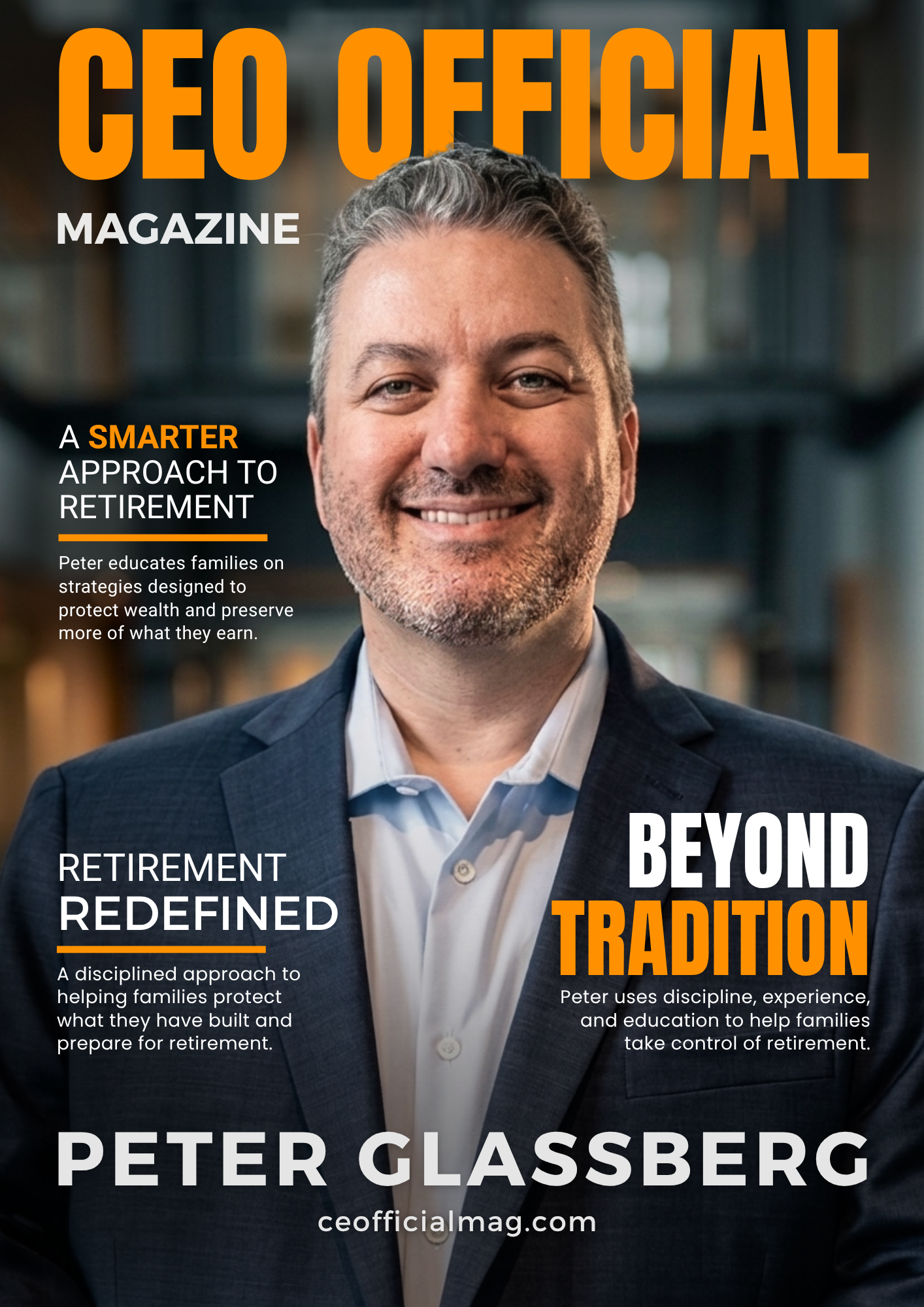
Many Americans are working hard, saving consistently, and doing what they were taught to do. They contribute to their 401(k), fund their IRA, trust the market, and hope that by the time retirement comes, their money will be enough.
But Peter Glassberg believes there is a major problem with this approach.
Too many people are trapped inside outdated, tax-deferred retirement strategies that expose their hard-earned money to unnecessary risk, hidden fees, and future taxation. While these accounts are commonly promoted as the standard path to retirement, Glassberg believes families deserve to understand what may actually be happening behind the scenes.
Through his focus on ERFT, which stands for Eliminating Risk, Fees, and Taxes, Glassberg helps individuals look at retirement differently. His mission is to educate people on how to move away from uncertainty and into more efficient, tax-advantaged strategies designed to help them keep more of what they earn.
Breaking Free From Cookie-Cutter Finance
Peter Glassberg knows that no two financial journeys are exactly the same. Yet many Americans are placed into the same basic retirement planning formula.
Work hard. Save money. Put it into a 401(k) or IRA. Wait until retirement. Hope the market performs well. Hope taxes do not rise. Hope the account lasts.
For Glassberg, hope is not a strategy.
After retiring from the United States Air Force following a 20-year career in electronics, communications, and information technology, Glassberg learned the value of discipline, structure, and preparation. His years in the military taught him that strong systems matter. Planning ahead matters. Reducing exposure to unnecessary problems matters.
That same mindset now shapes the way he approaches financial education.
Before entering financial services, Glassberg also served for eight years as a Volunteer Income Tax Assistance tax preparer. That experience gave him an early view into how taxes impact families and how easily people can feel overwhelmed by financial decisions they were never properly taught to understand.
When he was later introduced to financial strategies centered on reducing risk, fees, and taxes, he saw a different way forward. Instead of simply helping people accumulate money, he became focused on helping them protect, access, and retain more of it.
The Pitfalls of Tax-Deferred Accounts
Tax-deferred accounts such as 401(k)s and IRAs can be useful tools, but Glassberg believes people need to understand the drawbacks before relying on them as their entire retirement strategy.
Some of the most common pitfalls include:
- Heavy Taxation: Traditional retirement accounts do not eliminate taxes. They delay them. When money is withdrawn later, those withdrawals may be taxed as ordinary income, often during the years when people need their money the most.
- Hidden Costs: Fees can quietly eat away at long-term growth. Management fees, fund fees, advisory fees, and administrative costs may seem small each year, but over time they can reduce the amount of money that keeps compounding.
- Market Risk: Many retirement accounts are directly exposed to market volatility. When the market drops, account values can fall sharply, which can be especially damaging for people nearing or entering retirement.
- Limited Access: Retirement funds are often locked away until age 59 ½. Accessing money early can trigger penalties and taxes, making it harder to use your own money when emergencies or opportunities arise.
- Future Tax Uncertainty: No one knows what tax rates will be decades from now. A tax-deferred strategy depends on the assumption that future taxation will be manageable, but that is not guaranteed.
- Required Withdrawals: Traditional retirement accounts may eventually require distributions, whether the individual needs the money or not. This can create unwanted tax consequences and reduce flexibility.
- No Guaranteed Retirement Outcome: Having money in an account does not automatically mean that money will produce the income, stability, and protection a person needs in retirement.
Glassberg helps clients recognize that the real issue is not just how much money they have accumulated. The deeper question is how much they will actually get to keep.
Why Risk, Fees, and Taxes Matter
Many people focus heavily on the rate of return. They want to know how much their money can grow. But Glassberg believes that growth alone does not tell the full story.
If money grows but is later reduced by taxes, weakened by fees, restricted by account rules, or exposed to market downturns at the wrong time, the final outcome may be far less than expected.
That is why Glassberg focuses on ERFT.
ERFT is built around three major wealth disruptors:
- Risk: The possibility that market losses, poor structure, or lack of protection can damage long-term wealth.
- Fees: The ongoing costs that can quietly reduce account value and weaken compounding.
- Taxes: The future obligations that can reduce retirement income and limit how much money a person actually keeps.
For Glassberg, financial planning should not be product-driven. It should be outcome-driven. The goal is not to place every person into the same account or strategy. The goal is to help them build a financial structure that supports their needs, goals, family, and long-term future.
Are You Taking Advantage of Tax-Free Strategies?
Transitioning from tax-deferred thinking to tax-free strategies can feel unfamiliar at first, but Glassberg believes this is where many people need better education.
A tax-free or tax-advantaged strategy is designed to help individuals reduce the impact of taxes, protect more of their money, and create greater control over how they use their wealth.
One strategy Glassberg educates clients on is the use of properly structured Indexed Universal Life, also known as IUL. When designed correctly under IRS guidelines such as Section 7702, an IUL may provide a powerful combination of protection, growth potential, flexibility, and tax advantages.
The benefits of properly structured tax-free strategies may include:
- Tax-Advantaged Growth: Cash value may grow without annual taxation, allowing more money to continue working over time.
- Tax-Free Access: When structured and managed properly, policy loans may allow access to cash value without the same tax treatment as traditional retirement withdrawals.
- Principal Protection Features: Indexed strategies may offer protection from direct market losses while still allowing for growth potential based on market index performance.
- Uninterrupted Compounding: When money is not constantly reduced by unnecessary fees, losses, and taxes, more of it may remain positioned for long-term growth.
- Liquidity and Freedom: Properly designed strategies may provide access to funds for retirement income, emergencies, education, opportunities, or other needs.
- Legacy Benefits: Life insurance-based strategies may also provide a death benefit that can help protect and support loved ones.
Glassberg does not present these strategies as one-size-fits-all solutions. Instead, he believes they should be properly designed, properly funded, and aligned with the individual’s larger financial goals.
The power is not just in the product. The power is in the structure.
Why This Knowledge Is Often Overlooked
Many Americans are never taught how tax-free strategies work.
Traditional financial education usually focuses on tax-deferred accounts, employer-sponsored plans, and market-based investments. While these tools may have a place, they are often presented as the only path.
Glassberg believes that creates a knowledge gap.
Most people know they should save for retirement, but they may not understand how their accounts are taxed. They may not know how fees affect compounding. They may not realize how market losses near retirement can impact income. They may not understand that different financial structures may offer more flexibility, protection, and tax efficiency.
This is why education is at the center of Glassberg’s work.
He helps people understand the difference between simply growing money and efficiently using money. He teaches clients how to look at the full picture, including risk exposure, fee drag, tax consequences, liquidity, and long-term control.
In the past, pensions provided many workers with a sense of guaranteed income and security. Today, pensions are far less common, and many families are expected to build their own retirement income using tools they may not fully understand.
Glassberg believes that if the responsibility has shifted to the individual, the education must shift as well.
A Mission Rooted in Service
Peter Glassberg’s commitment to financial education is deeply connected to his personal background.
During his Air Force career, he lived by values such as integrity, service, and excellence. He also served as Base Honor Guard Commander at three installations, helping lead ceremonies, military funeral honors, parades, and formal events. That role strengthened his understanding of responsibility, service, and showing up for families during meaningful moments.
Those values now carry into his financial work.
His approach is not about pushing products. It is about helping people gain clarity. It is about helping families understand where their money may be exposed and what options may exist to improve their financial future.
Glassberg is also driven by his own family. He and his wife, Maribel, were married in Japan while he was stationed overseas. As a father, including to a son diagnosed with autism and children with ADHD, he understands the importance of planning, protection, and building a legacy.
For him, financial planning is not just about retirement accounts. It is about family stability. It is about future options. It is about making decisions today that can protect the people who matter most tomorrow.
Leading the Charge in Financial Education
Glassberg’s business has continued to grow as he helps more people understand the importance of reducing unnecessary risk, fees, and taxes.
He earned his Life Insurance License in Maryland and advanced to Regional Vice President with Freedom Equity Group within his first two years in the industry. He has also worked directly with clients to implement IUL strategies and continues to deepen his knowledge through retirement income planning education.
His alignment with XTreme1 Financial and Danny Singson further strengthened his commitment to a structured, systems-based approach to financial strategy.
Looking ahead, Glassberg plans to continue expanding his impact through education, scalable systems, and client-focused strategies. His long-term vision is to help more families challenge outdated retirement assumptions and build more efficient financial structures.
Helping Families Keep More of What They Earn
Peter Glassberg’s ERFT approach goes beyond traditional financial advice. It is a call for individuals and families to look more closely at how their money is structured, what risks they may be carrying, what fees may be reducing growth, and what taxes may be waiting in the future.
By helping clients move from tax-deferred thinking toward tax-free and tax-advantaged strategies, Glassberg empowers them to take greater control of their financial future.
His message is clear.
It is not enough to simply save money. You need to understand how your money works. You need to know what can erode it. You need to explore strategies that may help protect it, grow it, access it, and pass it on more efficiently.
For anyone who feels uncertain about traditional retirement planning, worried about taxes, or concerned that their current strategy may not be enough, Peter Glassberg offers education, clarity, and a more intentional way forward.