

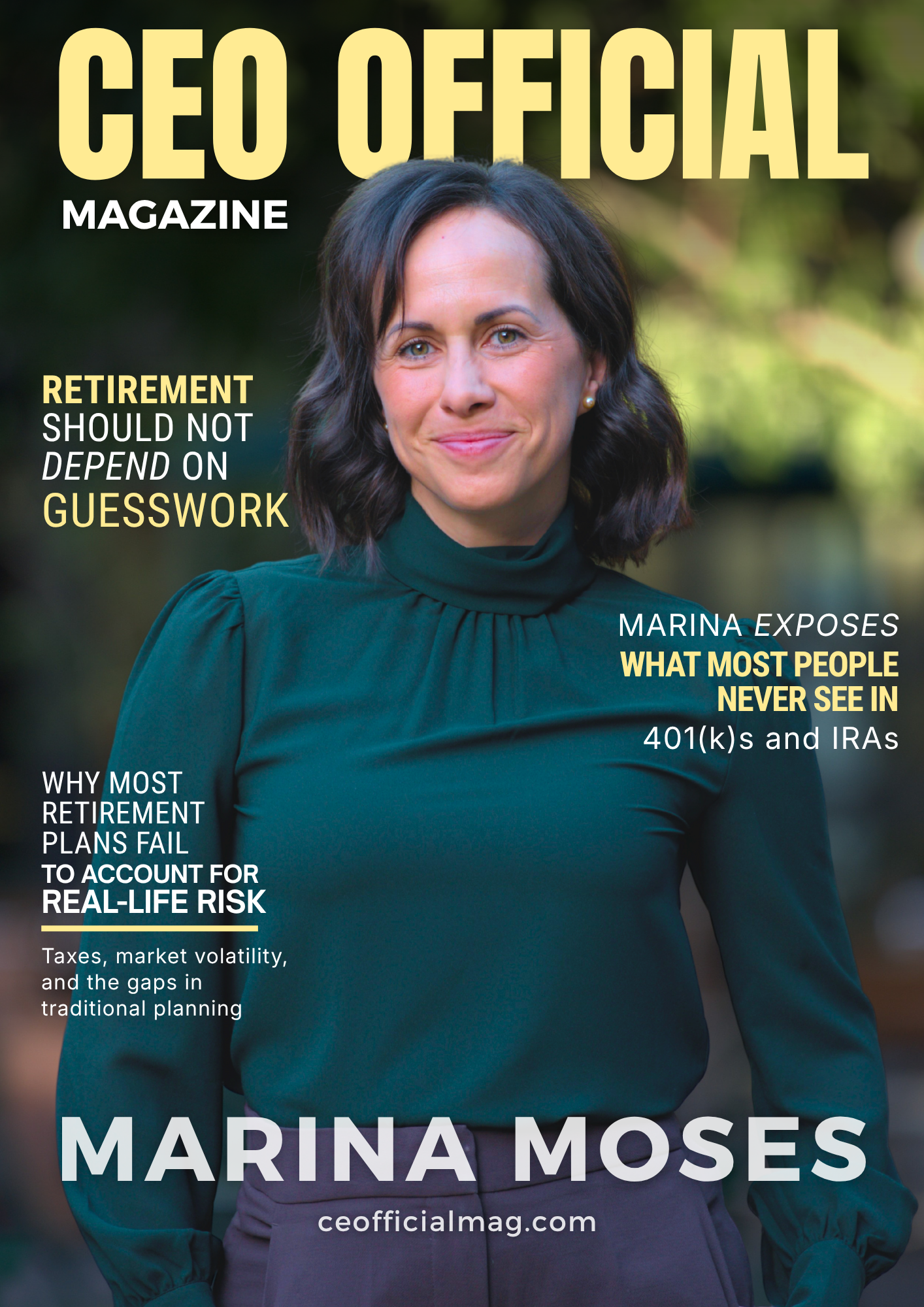
Marina Moses spent over 15 years inside corporate finance, learning firsthand how Fortune 500 organizations protect and grow their money: through long-term strategy, tax control, and disciplined risk management. Today, she brings that same boardroom-level thinking to individuals and families who have never had access to it before.
Her mission is simple: teach people how to build wealth while sidestepping the pitfalls most retirement plans never warn them about. Years in corporate finance taught her something most people never learn, even highly educated professionals rarely have access to the same wealth-building strategies that corporations, banks, and affluent families use as a matter of course.
For decades, the standard advice has been to max out a 401(k) or IRA: work hard, contribute consistently, trust the market, retire someday. But according to financial educator, Marina, that advice leaves millions of hardworking families exposed to unnecessary taxes, market losses, hidden fees, and financial uncertainty they never signed up for.
So she built her business around something different: helping individuals and families understand financial strategies built around protection, tax efficiency, and long-term control.
From Corporate Finance to Financial Empowerment
Marina’s background is deeply rooted in finance.
Her years in corporate finance helped organizations optimize financial systems, improve efficiency, and strategically manage money. The deeper she got into that world, the more obvious something became: the same strategies corporations use to manage risk, control taxes, and plan for the long term aren’t exclusive to boardrooms. They apply just as effectively to a single household.
That realization sparked the obsession.
Marina models financial outcomes across every variable she can imagine: different market conditions, fee structures, and tax scenarios both favorable and unfavorable. The deeper she digs, the clearer it becomes: an entire world of planning exists around the unpredictable future, and most people are completely missing it.
That analytical edge has become her greatest advantage. Where others see uncertainty, Marina sees a problem she is uniquely equipped to solve.
Her deep background in financial modeling lets her think several steps ahead on behalf of her clients: stress-testing plans, anticipating risks, and building strategies resilient enough to weather what no one can predict.
The result? Her clients don’t carry the mental burden of “what if.” That weight becomes hers to manage, so they can live with confidence and peace of mind.
The Pitfalls of Traditional Retirement Accounts
Marina spends much of her time helping people understand the hidden weaknesses inside traditional retirement plans like 401(k)s and IRAs. The financial industry widely promotes these accounts as retirement staples, but Marina believes most people remain unaware of the long-term consequences attached to them, simply because the accounts have become so common nobody questions them.
Pitfall #1: Tax-Deferred Does Not Mean Tax-Free
One of the biggest misconceptions in retirement planning is believing tax-deferred accounts eliminate taxes. They don’t. The government simply postpones the bill. That means retirees may eventually owe taxes on both their contributions and their growth, at future rates that could run much higher than today’s, depending on whichever political winds happen to be reshaping the tax code at the time.
“Most people don’t realize they’re building a future tax bill,” Marina says. “The IRS eventually wants their portion, and what they want today may be far different than what they want tomorrow.”
As withdrawals increase, retirees can face substantial tax obligations during the exact stage of life when they need stability most.
Pitfall #2: Market Volatility Can Erase Years of Progress
Market performance drives traditional retirement accounts directly. The market can deliver strong growth in good years, but downturns can erase decades of gains just as quickly. For people nearing retirement, a major correction can be devastating.
“You spend your entire life building your nest egg,” Marina explains. “Then one bad market cycle can dramatically reduce your savings. 401(k)s and other market-based strategies have normalized this risk, but if we see it for what it actually is, we can’t call it ‘saving.’ It’s more like gambling, and everyone’s betting their retirement at the casino.”
This ‘sequence-of-returns’ risk is one of the major reasons Marina pushes families to explore more protected financial strategies.
Pitfall #3: Hidden Fees Quietly Reduce Wealth
Hidden fees are another issue Marina frequently educates clients about. Many retirement accounts carry advisory fees, administrative costs, management expenses, and mutual fund fees that silently chip away at long-term growth. Even small percentages compound into significant losses over decades.
“People rarely realize how much money is leaking out of their accounts every year,” Marina says. “Those fees can cost families hundreds of thousands of dollars over time, no matter how small or innocuous they look on paper.”
Pitfall #4: Limited Access and Lack of Control
Most traditional retirement plans come with age restrictions, withdrawal penalties, and limited liquidity. In many cases, people can’t access their own money before retirement age without paying penalties or taxes. Marina believes financial security has to include flexibility and control.
“Your money should be accessible when life happens,” she says. “Not trapped behind restrictions and fine print. This is America, after all, the land of freedom and opportunity, and being restricted from your own money is no freedom at all.”
A Different Kind of Wake-Up Call
Marina’s interest in tax-free strategies started with a question she couldn’t let go of: what is inflation actually doing to people’s money, why does almost no one explain it clearly, and how is it making long term saving ever more difficult?
That question became the foundation of The New Rules, a report Marina wrote walking through what’s happened to the dollar’s purchasing power over the past century and what it means for anyone trying to save for the future.
“The dollar has lost 97% of its purchasing power since 1913,” Marina says. “That’s not speculation, it’s math. Most people are still saving the way their parents did, inside a system built for a different era.”
That erosion is only half the story, Marina says. Inflation barely stung during the booming decades after World War II; now it’s reaching critical mass, and every American needs to pay attention to the other half of the equation. Inflation itself sits outside any one person’s control, but plugging what Marina calls the “three leaks” doesn’t. Left unchecked, these leaks quietly drain most people’s retirement savings: risk, fees, and taxes.
Risk is the most visible one. A downturn at the wrong moment can permanently alter someone’s retirement timeline. Fees work quietly: a small annual percentage, compounded over thirty years, can consume close to a third of a portfolio’s potential gains, often without the account holder ever seeing a bill for it. And taxes are the most misunderstood of the three. Traditional retirement accounts don’t eliminate taxes, they postpone them, leaving the eventual rate up to future policy nobody can predict.
“Banks, corporations, and wealthy families have used strategies to plug those leaks for decades,” Marina explains. “The average saver was just never invited into that conversation.”
Marina built her business around closing that gap: moving client savings into structures designed to grow, stay protected from market losses, and compound without the same tax exposure as a traditional account.
The Power of Uninterrupted Compounding
One concept Marina returns to often is uninterrupted compounding. Traditional losses create a setback that’s easy to underestimate: a portfolio that drops 30% needs significantly more than 30% growth just to get back to even. “That recovery time can steal years from someone’s financial future,” Marina says. Strategies built around capital preservation remove that interruption entirely: they prevent the loss from happening in the first place. “It’s not just about making money,” she explains. “It’s about keeping your money consistently growing.”
Building a Legacy of Possibility
Outside of business, Marina is an avid hiker, and she’s quick to point out the parallel: building financial security takes the same resilience and discipline as climbing. You keep moving even when the path gets difficult, because you know what’s waiting at the top.
That mindset drives where she’s headed next. Marina’s goal over the coming years isn’t just to grow her client base, it’s to put the same strategies corporations have used for decades into the hands of everyday families: tools that protect against risk, reduce unnecessary taxes, and grow without the leaks that quietly drain most retirement plans.
“I want people to know they can rewrite their financial story,” Marina says. “You are not stuck with the traditional path just because it’s what everyone else is doing.”
That’s the legacy she’s building: proof that the strategies once reserved for boardrooms belong to regular people too, and that it’s never too late to start using them.
CLICK HERE for more details.