

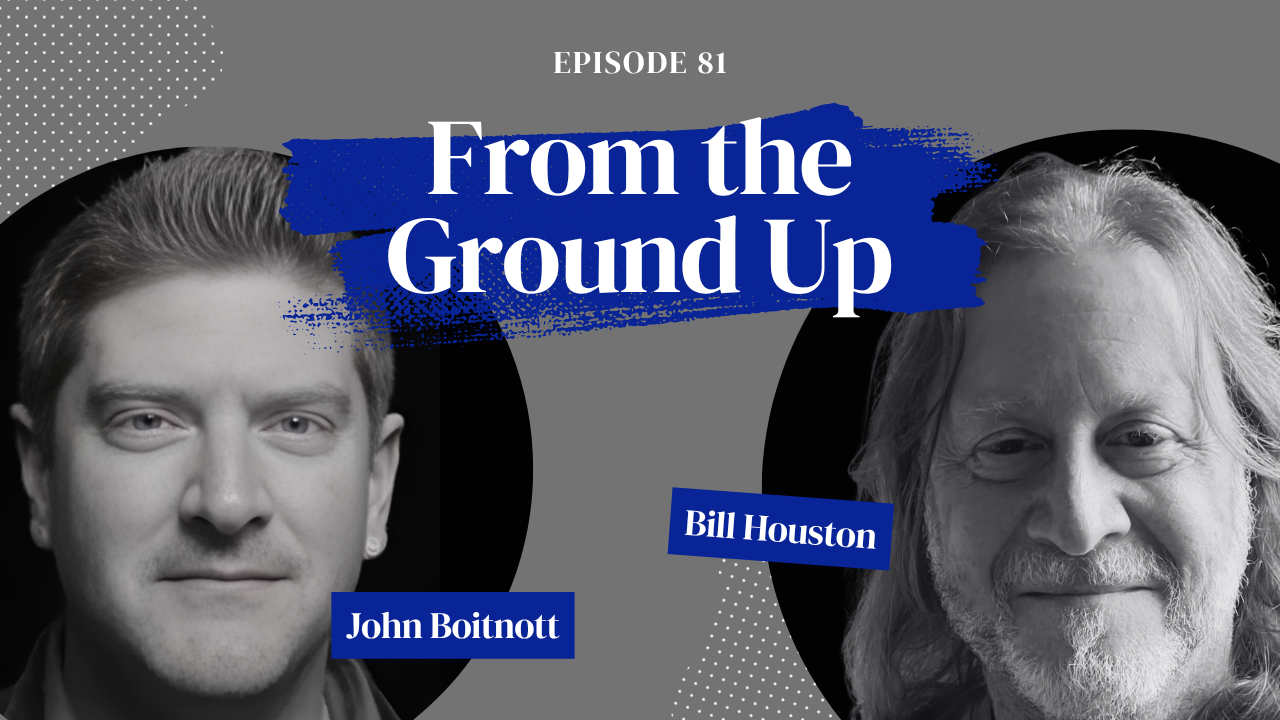
Bill Houston spent decades building a successful professional life while alcoholism grew alongside it. He earned three degrees, including a PhD in geology, worked in the oil and gas industry and nonprofits, and eventually became a college professor. Drinking remained woven through much of that career until the physical consequences became impossible to separate from everything else.
After roughly 35 years of alcohol use, Houston developed severe liver disease and received a transplant in 2019. Recovery from the operation took years. His body had to regain strength, while cognitive problems forced him to reconsider how his brain was functioning after years of heavy drinking, serious illness, anesthesia, and deconditioning.
That period changed the direction of his work. Houston eventually began working in sober housing, outpatient settings and a methadone clinic before moving further into training and advocacy. Today, through Recovery Road Less Traveled, he focuses on helping people understand substance use disorders, mental health conditions, and trauma with enough depth to make informed decisions about recovery.
Recovery Cannot Be Reduced to One Method
Houston’s own treatment experience showed him why a program can help someone while still leaving important needs unmet.
He spent seven weeks in treatment during 2019, shortly before his liver transplant. The program leaned heavily toward a traditional 12-step, abstinence-based model. Houston credits that treatment with helping save his life and establishing the sobriety he has maintained since then. Yet the material that stayed with him most strongly came from educational sessions that explained what was happening inside the brain.
A physician once gave a short presentation on serotonin. Houston, who describes himself as a lifelong science nerd, wanted much more of that kind of information.
He eventually realized that other patients might need entirely different forms of understanding. Someone carrying significant trauma may need to explore that history before a recovery plan begins to make sense. Another person may be dealing with substance use alongside depression, bipolar disorder, ADHD or another mental health condition. Treatment becomes much harder when everyone is expected to respond to the same explanation of why they use substances and how they should stop.
Houston approaches that complexity as an educator rather than someone trying to impose a predetermined route. His work as a certified peer specialist allows him to draw appropriately from his own experience while meeting people without immediately demanding that they adopt a particular identity or treatment philosophy.
“These aren’t bad people trying to be good,” he says. “They’re sick people trying to be well.”
Knowledge Can Give People Something to Act On
Houston discovered an important part of his own story only after his transplant, when neurological testing pointed toward adult ADHD.
The diagnosis helped explain traits that had been present long before his drinking became severe. He had done well academically, so there had been little reason during his childhood to investigate why he could be restless, highly verbal or mentally scattered. As an adult, some of those characteristics even helped him professionally. Geology rewarded intellectual curiosity and the ability to work creatively with incomplete information.
Alcohol complicated that picture. What Houston had interpreted partly as a way to calm himself eventually damaged his health and impaired the thinking he relied on professionally.
That experience informs his broader belief that education can give someone an initial foothold in recovery. A person may discover that what seemed like a character flaw has a neurological, psychological or behavioral component that can be understood and managed. Someone else may learn that trauma has been shaping reactions they never knew how to explain.
Houston does not assume that every person wants a technical explanation. He instead looks for the missing piece of knowledge that matters to that individual. Even a small realization can restore a sense of agency when someone has spent years believing nothing can change.
Employers and Communities Have a Role
Houston believes the same principle applies beyond treatment facilities.
Workplaces often encounter addiction only after performance has deteriorated enough to create a personnel problem. By that point, managers may see termination as the simplest response. Houston argues that employers should recognize substance use disorders as health problems and consider whether support can preserve a valuable employee before the situation becomes irreversible.
Communities face a similar challenge when treatment centers, methadone clinics, syringe programs or other harm-reduction services are proposed nearby. Fear can take over before residents understand what those services actually do.
Houston’s preferred response is education at the community level. Bring residents together, explain the evidence, allow disagreement, and answer difficult questions without treating skepticism as hostility. He believes durable recovery systems depend on people understanding why services exist and how they can reduce harm before someone is ready or able to pursue full recovery.
The underlying principle is the same one Houston now applies to individuals: people are more likely to make useful decisions when they understand what is happening to them and know they can ask for help without first proving that they deserve it.
Want more From the Ground Up? Check out more articles or head over to YouTube, Apple, or Spotify to watch the videos.